From the Hive
What Basic Life Support (BLS) Training Covers
· Updated
Basic Life Support (BLS) training teaches high-quality CPR for adults, children, and infants, how to use an AED, how to relieve a blocked airway, how to respond to an opioid overdose, and how to work as a coordinated team until EMS arrives. The American Red Cross designs its BLS course for healthcare and public safety professionals. It takes about four to five hours in person, ends with a skills check, and leads to a certification that lasts two years. BeeReady volunteers train to this standard, and this guide explains what it covers and why we chose it.
What is BLS training?
BLS is the core resuscitation course for people who may need to respond to cardiac and breathing emergencies as part of their work or volunteer role. The American Red Cross says its BLS certification is most often taken by nurses, physicians, paramedics, and EMTs, along with other healthcare and public safety clinicians. The course content is developed and reviewed by the Red Cross Scientific Advisory Council, a group of medical, scientific, and academic experts, so it reflects current evidence and guidelines.
What skills does BLS training cover?
The Red Cross lists these topics in its BLS course:
- Rapid assessment and visual survey of the scene and the person
- CPR and AED use for adults, children, and infants
- Obstructed airways, including choking
- Opioid overdoses
- Critical thinking, problem solving, communication, and teamwork
- The emergency medical services (EMS) system
- Legal considerations and precautions
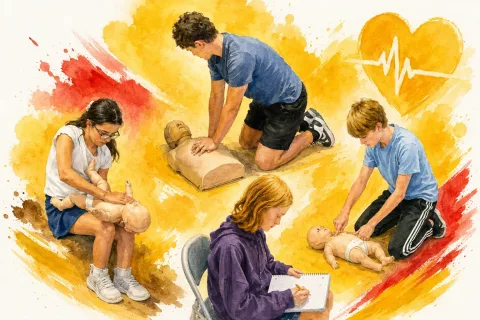
Compression skills are practiced to specific targets. For an adult, the Red Cross teaches pushing hard and fast at least 2 inches deep at 100 to 120 compressions per minute. For a child the target depth is about 2 inches, and for a baby about 1 and a half inches, at the same rate. Learners practice on adult, child, and infant manikins so they can feel the difference.
How is BLS different from a standard CPR class?
A community CPR class is built for lay responders: parents, coaches, and coworkers who want to act in an emergency until help arrives. BLS covers the same lifesaving foundation of compressions, breaths, and AED use, and adds what a professional rescuer needs: a structured rapid assessment, resuscitation as a coordinated team with clear roles and communication, opioid overdose response, and how the rescuer fits into the EMS system. It is also more demanding to pass, because each learner must show the skills to an instructor.
Does BLS cover first aid?
No. BLS focuses on cardiac and breathing emergencies: cardiac arrest, choking, and opioid overdose. First aid is a separate Red Cross course that covers a wider range of conditions, such as asthma emergencies, severe allergic reactions, bleeding, burns, diabetic emergencies, environmental emergencies such as heat illness, head, neck, and spinal injuries, seizures, and stroke. Choking appears in both. If you want first aid as well, the Red Cross offers classes that combine first aid, CPR, and AED training.
How long does BLS training take, and how long does it last?
According to the Red Cross, an instructor-led BLS course takes about four to five hours. The blended option combines one to two hours of online coursework with a two to three hour in-person skills session. Certification lasts two years. A shorter recertification course is meant for people whose BLS certification is still current or expired no more than 30 days ago. Red Cross digital certificates carry a unique ID and QR code that employers and leagues can use to confirm a certificate is valid.
Why do BeeReady volunteers train to the BLS standard?
We could ask volunteers to watch a short video and call it done. We do not. A youth sporting event has players of every age, from small children to teens, plus adult coaches, parents, and grandparents in the stands. BLS prepares a volunteer for all of them, and its team-based training fits the way a sideline response really works: one person starts compressions, another brings the AED, another calls 911 and guides responders in. Training to the BLS standard means that when our volunteers step in, they have practiced real skills and been checked on them.
What does BLS training mean for young athletes and families?
For the families we serve, BLS training is a promise. It means the people standing near the field are not just well-meaning, they are prepared. Combined with an AED on site, that readiness gives a young athlete the best possible chance if the worst ever happens.
Want this training for your team or league? Use the group training link on this page. This article is educational and is not a substitute for completing a certified BLS or CPR course with a qualified instructor.